What has likely gone unnoticed by everyone but me, is a recurrent pattern among most introductory sections of my authorship. Each time this entails the presentation of two claims; the first is more broad and digestible, while the second acts as a provocative extension, it’s more specific, and harder to prove. And while I like this format, finding it helpful when introducing theory, it has never been repeated with intent. I don’t like repetition, but in catching myself again, I’m beginning to suspect it just can’t be helped.
So—my first claim: (1) Religious traditions and belief systems evolve in a manner structurally analogous to biological evolution. This occurs through dynamic, non-teleological, syncretic adaptations; each belief system is inherited, and they undergo modification, recombination, and selective preservation; selection defines the religion more than the doctrines subject to selection.
And: (2) the Greco-Roman god Apollo did not altogether disappear with the suppression of paganism. As I aim to show, a deity identified with Apollo in antiquity appears to have survived under a Christian identity, retaining not only a recognizable name but something resembling his former religious function, although perhaps in a neutralized fashion.
Evidentiary matters are to be addressed throughout the text along with much qualification. As far as qualifications are concerned, the first to be addressed will provide a theoretical means through which both claims are made possible. And as for beginning, we already have.
I. Syncretism
A syncretic religion assumes the model of an intermixed belief system. Syncretism itself describes a cultural confluence in which two or more religious traditions interact recursively; and as each leaves a trace on the other, a lasting vestige remains in the historical record.
This serves us when we seek to explain why it is that "the same" belief system practiced at two distant points on a map, or far apart on a timeline, will inevitably leave in their likeness a confounding level of variability. And it’s especially helpful when addressing a question now aimed at you; What is the difference between Christians today and Christians millennia ago—?
Don’t worry, I’ll answer: Quite a lot. For one, Christian’s didn’t always put up a Christmas tree as they’ll surely be found doing in December. And this is odd, because not Mathew, Mark, Luke nor John would be found adorning pines with strange orbs as your most Christian aunt will be doing—and that’s without mentioning those sacrificial carrots left out for the flying horned deity named Rudolf.
Now, whether you think your aunt here is heretically practicing a cultic-pagan ritual and needs to be stoned, or is merely playing "reindeer games," will be left entirely to the reader’s discretion. My only point is in calling to mind a difference between Christians today and those in the distant past—and, in the case of the Christmas tree, that difference is (roughly) a Christianized Germany.
The centuries following the fall of Rome seems to be a time where little else was done short of a widely-defined Germanic people’s conversion en masse to Christianity. Syncretism applies here because we know that Christianization happened to Germany, but as your aunt has helpfully made apparent, so too did Germanization happen to Christianity.
Crucially, syncretism describes mutual acculturation, i.e., it shouldn’t be understood as only affecting one side of a bilateral axis; it goes both ways. And furthermore, we must understand it as an active, ongoing process that is as ubiquitous as it is constant.1 And this presupposes your finding that there is no such a thing as a pure religion, as none are uncorrupted by influence (then only muddied-up by someone’s aunt down the road).
When I point out that neither consistency nor uniformity is ever a characteristic among any religion, we are only observing that none are free from outside interference; and I’m not necessarily pointing this out as a critique—or at least, I am not proposing anything that Christian scholars such as Alistair McGrath (for example) have not already come to terms with:
McGrath identifies his faith’s “capacity to adapt to local circumstances” in Christianity’s Dangerous Idea. Here, the book notes precisely the mutual enculturation we are describing as syncretic—I would only add here that syncretism is, of course, not uniquely Christian before allowing the author to go on sounding even more like my biologically-oriented self; saying the religion is like “a microorganism, capable of rapid mutation and adaptation in response to changing environments.”2
Simply, no religion is without syncretism; it’s syncretism all the way down, and perhaps Christianity is only the most overt in terms of a clear case; i.e., it has a most apparent predecessor—one that’s imbedded down to its very root: no serious argument could be made to follow that the history of Christianity didn’t rely on Judaism as an indispensable, determinative source. But that much is obvious—so, what else might we find imbedded in Christianity . . ?
II. Apollo
Augustus constructed a temple to Apollo and attributed much of his military and political success to the god; the sole ruler of Rome appears to have favored him above all others.3 As Rome’s first emperor, Augustus presided over a remarkably crowded pantheon—however, by the fourth century AD, there seems to have been a curious inversion: Rome had gone from one emperor and many gods to several emperors and one officially approved God.
In relation to the Empire’s fault lines making themselves increasingly apparent, there there was also a clear up-tick in demand for emperors—far less tolerance for gods though; Theodosius I, together with Gratian and Valentinian II, famously issued the Edict of Thessalonica in AD 380. This regulation would make Nicene Christianity the official religion, followed by restrictions of paganism in AD 391-392.
One might imagine this settled the matter, and that Christianization would virally spread across Rome, then Europe in short order following the fall of Rome—but in much like Christianity itself, Christianization was never uniform nor particular in its timing.
Papal authority would not reach its zenith until AD 1198–1216 under Pope Innocent III, and even then “there was no consistent supra-regional definition of Christianitas” (as G. Thomas et al. detail). Even as European Christianity began to consolidate, we are still left with roughly six hundred years of the scholastic and regional incongruity that Petrarch would later label the “Dark Ages”—a term born of his relative dissatisfaction upon looking back to the Classical world preceding his own.
The decrees were not entirely comprehensive and in fact, permitted certain traditional public festivities and banquets to continue, provided they were separated from prohibited pagan sacrifice; the second protected temple buildings that had been cleared of illicit worship.
Furthermore, in AD 601, Pope Gregory the Great recommended a similarly adaptive policy when instructing a missionary that pagan temples in England shouldn’t be destroyed… Was the pope secretly pagan? Was he Apollo?—No. He was very clever however, and Pope Gregory only directed that their idols were to be removed, but not their buildings—which were to be preserved and consecrated, along with their accustomed celebrations which were then redirected toward Christian worship and the commemoration of martyrs.4
Again, and to clarify; the preservation of familiar structures was being recommended by a Christian authority precisely because it could facilitate conversion. It is worth considering what this means for our understanding of religious replacement. And there’s actually something Marx would appreciate here: resembling capitalism’s capacity to sell Che Guevara shirts, Christianity subsumed competitors into itself; it absorbed sacred places, religious calendars, ceremonies and cosmologies, thus neutralizing it in the process.
Whether you have many gods or one God it can change a lot about the way you interpret reality, however, it changes very little about the reality being interpreted to begin with; regardless, there is still demand for medical treatment, famine remains a threat, and the arrival of a plague is no less alarming just because a city has adopted Nicene orthodoxy. So, the demand for certain "spiritual goods" for pagans even after they were no longer pagans would preserve structural elements of (any) faith that have always been present—and sometimes Christians preserved these same pagan structures, if only to neutralize their pagan quality: a baptism of sorts.
And this brings us back to my second provocation, which, if you recall, concerned the possible continuation of Apollo’s worship beyond the periods usually considered. To investigate this, we’ll distinguish three forms of continuity: (a) structural, (b) functional, and (c) nominal.
Structure is to evolutionary physiologists what function is to evolutionary psychologists. But here; structure means recognizable arrangements, symbols, and practices associated with Apollo’s worship; by function, we’ll consider what those arrangements and the god himself were understood to supply in terms of "spiritual goods" (e.g., healing, purification, or protection against plague, and more to be detailed). Leaving my favorite letter; nominal continuity will concern the inheritance and transformation of Apollo’s many names.
O—by the way, Apollo has many names: Apollo is associated with Sol in ancient times, Ra in Egyptian myths, and Belenus in places most sane Americans have never heard of (e.g., Noricum). Even as Apollo, he’s referred to in writing under various names such as, “the Hyperborean” (meaning, “of the north”), “Phoebus” (the “Shining One”), “Nomios” (“Herdsman”), “Lyceius” (he likes wolves—or something like that), “the Pythian” (he killed a big snake), as well as “Acestor” (meaning “healer” or “averter of evil”). . . we could keep going, but you get the idea. Most relevant things have been addressed for now, but more information on Apollo (with answers to questions such as, “what else is he the god of?”) can be found here and certainly elsewhere. And here’s twenty-nine epithets too, just in case you run out of things to call him.
Naturally, resemblance of names alone will not suffice as evidence of Apollo’s alleged continuance. I am aware of this. What we’ll be keeping our eyes out for, however, is where the names can be traced through the historical record in genealogical fashion, or otherwise—where we can triangulate names, structures, and functions beyond what can be safely assumed as coincidence. Relevant names have been covered, but the structure and function of Apollo will demand mythological review:
Apollo is the Greek god of medicine and he’s even in the Hippocratic Oath. Named before his medically-inclined son, Asclepius, no less—the oath begins by evoking “Apollo the physician” (and the oath—btw, at no point says “first do no harm”).5 Medicine and healing are among the most important Apollonian associations for our purposes today, though, they are far from exhaustive:
Apollo was also a god of intelligence, music, foresight, archery, purification, and various bright things; the color white, light, the sun, truth and general blondness. His favorite flavor of ice-cream was undoubtedly vanilla, and whether that’s apocryphal or not, he is sometimes described in terms of "divine distance," being a god who "threatens from afar."6Which makes sense given his preference for the bow and arrow.
Yet the instrument was not his only means of inflicting harm: he could also send pestilence, and in the opening verses of Homer’s Iliad (and these two attributes should become conjugated in your mind—arrows and plagues) Apollo punishes Agamemnon’s army with plague-inflicting arrows.7 Apollo also enjoyed the lyre, poetry, dance, and many other activities, but we can’t be here all day.
So, let’s just concentrate on one more association before calling our mythology review sufficient: Apollo repeatedly presides over the boundary between sterility and renewal, pollution and purity, and over the ritual disposition of what falls outside the productive order. . .
Oh no, that’s a big one, and it’s going to take a lot to be made sense of. Well, we can think of this in a simplified manner and call him the god of agriculture and the god of borders—and, while that would be essentially true, even then, we’ll at least need an example. The best one is offered in a description of a core ritual relating to Apollo’s worship, which will become increasingly relevant, and to which we will now turn:
III. Scapegoats
It’s worth noting that natural selection creates order from chaos—but interestingly, this creativity is done as a sculptor makes a statue out of marble: by removal alone.
Several millennia ago, there was once an annual festival of purification that was characteristically dedicated to Apollo. Most common to ancient Athenians and Ionians, the event was referred to as "Thargelia,” and the celebration would entail the selection of an unfortunate pair of citizens.
The two selected were referred to as pharmakoi (or in singular form, pharmakos) and these scapegoats were chosen on the basis of their imperfections; they were "considered ugly," and they were considered as much in the broadest sense of the word: each was likely a slave, a criminal or they were disabled.8
Perhaps all three at once if you’d been good that year. But in any case, the pharmakoi were to be ugly outcasts of the most unfortunate variety—however, there is one complexifying caveat; only they could purify the community. Now, note the dualism here—but don’t get obsessive: this is only as confounding as a related word, “pharmakon,” with its original meaning at once signifying a poison and a cure.9
Indeed, the related word pharmakon referred to medicine for the Greeks as much as our word “pharmaceutical” continues to today; and while there may appear to be much difference between our word and theirs; insofar as that difference exists, doesn’t their definition only make more sense in spite of the contradiction? Don’t many vaccines carry the very virus deployed to then prevent an infection it would otherwise cause? Isn’t antivenom produced by the same response as the venom it’s designed to neutralize?
Where pharmacodynamic tolerance is leveraged is often where the answer remains, yes. As infected then injected, the same principle is again taken advantage of in the field of psychology today; exposure therapy remains the best answer to a phobia. And so, the poison is often the cure, and vice versa; medicine persists as poison. In similar fashion, the ugly pair chosen as pharmakoi would carry away the ills of their community. As such, they were exiled, if not sacrificed.
Removed of the lowest elements, the polis was expiated and Apollo propitiated. On that same day, celebration would ensue as there was clearly much to celebrate; along with purification there were celebrations for the fall of Troy, the victory of Marathon and Plataea, and even the victory of Alexander the Great’s defeat of Persia. Jan Bremmer writes that the Athenian removal of their pharmakoi and purification of the city “seemed to be the appropriate day to celebrate these victories:”10
Bremmer then notes that at Apollo’s Thargelia, marginal persons (i.e., people within the border who ought better be outside of it) were symbolically associated with wild and unproductive vegetation; they were expelled from the community, and succeeded by rites of first fruits and seasonal renewal—at once giving Apollo the association of agriculture and borders alike.
Times of crises seem to have invited extra purificatory "Thargelias," e.g., in times of plague. Now, we must understand that general medical concerns as well as plague management, boundary purification, the ritual disposal of what threatens societies, are common interests for all people across all times, i.e., they were not exclusive concerns of pagan religions which Christianity could afford to dismiss. There was demand for these roles to be carried out by a deity because they offered answers to recurring crises.
When plague struck a medieval community, the need for protection and purification didn’t go anywhere just because pagan gods had been condemned legally or otherwise. "Spiritual demand" persisted, and belief systems must adapt to their consumer; had they not evolved around these needy customers, and supplied whatever symbolic and institutional means were available, they would be found in the scrapheap of failed religions.
Apollo’s persistence at the functional level of analysis accounts for the role he fulfilled rather than the name he was ascribed; his essential work, i.e., healing, plague prevention, the maintenance of sacred boundaries, etc. etc—this demand previously met by polytheistic gods would ultimately find new names and new forms incorporated into the Christian framework. . . How—?
IV. Saints
In the famous work, The History of the Decline and Fall of the Roman Empire, Edward Gibbon details the cult of saints as a “popular mythology, which tended to restore the reign of polytheism.” And this turns out to be a compelling answer to the question of how the function of numerous deities were accommodated.
Of course, Catholic theology precludes this through doctrine that distinguishes the veneration of saints from the worship of separate gods… However, in truth, this did very little to preserve the remains of saints whose bones were being stolen in the first millennia of Christianization for "personal use."11
A box, however—was exactly the kind of arrangement you’d need to have in place if you (a) were a Syriac Christian in the 7th century, who (b) seemed notably holy as you were (c) about to die, and (d) didn’t want your remains used in magical rituals—lest you preferred being bowdlerized into powder and then eaten; or wished to provide "assistance in cases of infertility" to your fellow Christian.12 Though, post mortem stratagem and even defending monks didn’t stop the less-famous of two Christian "John’s" from getting his hand stolen following a Christian faction having ransacked his fresh corpse:13they would be camping out as you were about to depart; this is a time and a locale where Christians were "keen not to miss an opportunity to acquire a fragment of a saint’s relic whenever such an occasion arose."14
So, does this sound like doctrinal Christianity to you? Regardless, this is exactly what was transpiring in early Christianized environments. And it would continue among early Christians in places like Syria-Mesopotamia—the citizens of whom, seem to have been more affected by their environment than by any doctrine coming from Rome, wouldn’t you say? Syria is only known for its peace, after all… I’m sure it was only made more pleasant in a time before printing and mailmen, when any doctrine must’ve only come requiring translated, then retranslated scraps of something less-than-legible; which helpfully left a retranslated-retranslation for a reader, who in fact, couldn’t.
"But that’s Syria"—you might retort. Well, sure, but Prussians buried their dead with live horses until about 1400.15 Magic that consistently failed to produce results was practiced all across "Christendom" (the title of which is negated by its own lack of uniformity) for over a thousand years. And yes, these rituals were often dedicated to local saints or their venerated objects—sometimes their corpses, and this occurred regardless of what any pope (or antipope) was prescribing.
In fact, we’ll shortly be turning to a location in Italy who not only disregarded the Pope’s advice, but was quite literally at war with Rome throughout their time disregarding it. It is hard to believe these Medieval proto-Italians were simultaneously worried about the Church and its distant specificities, more than their own accustomed regional practices that had gone on nearly a millennia prior. Are we to expect they prioritized the Pope’s doctrines while simultaneously trying to kill him—?
For better or for worse, if you are a Christian today, you are not a Christian of the past. But hey, you think rubbing bone powder on yourself to heal wounds is weird; St. Ephrem would assume Christmas is Santa’s birthday and no one else’s. To each their own. But okay, let’s be a bit more conservative with the argument:
If Christianity did not necessarily restore polytheism, the least that could be said is that it developed institutions capable of performing many of the services in which pagan divinities had previously been invoked. And although the plurality of functions associated with Apollo will remain important, I suspect the plurality of his names may prove considerably more revealing. . .
In AD 238, the Roman historian Herodian describes Aquileia’s resistance to the emperor Maximinus Thrax, whose attempt to seize the northern Italian city encountered considerably more resistance than he had anticipated. Maximinius was the first Roman Emperor to have began his career as a soldier and then rise through the ranks to become Emperor of Rome. But in 238, Maximinius had lost the faith of his soldiers and they murdered their general near Aquileia, along with his son, following his defeat by Aquileia’s inhabitants, of whom expected protection from their native god they identified with Apollo, though he was worshipped locally under a name that Herodian renders as Belis.16
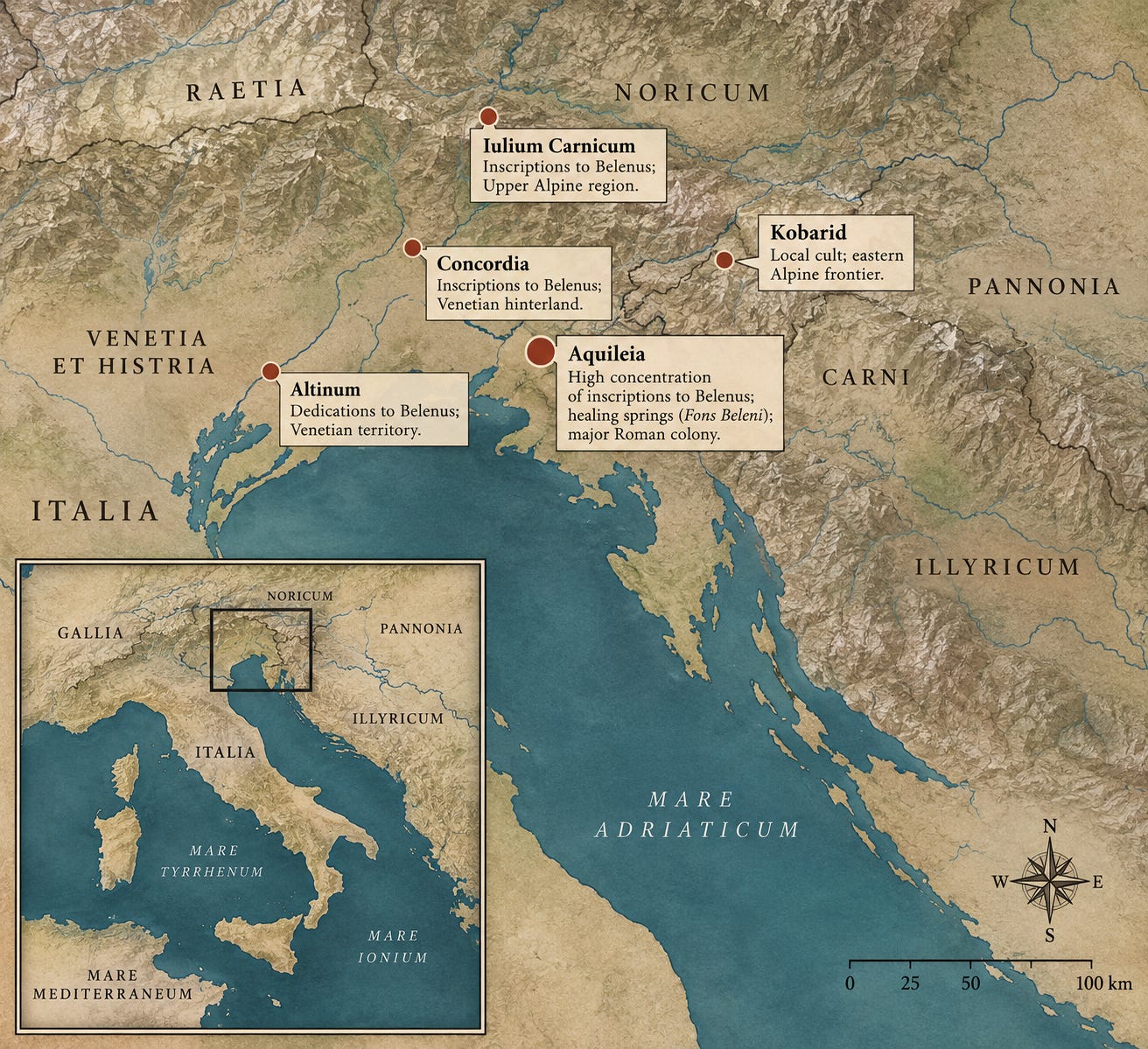
The deity is associated with Belenus (or Belinus/Belinos) who I mentioned earlier, and was the Patron god who "had been widely venerated during the Roman Republican and Imperial periods in Eastern Venetia and Noricum". The cult of Belenus was practiced in northern Italy; the broader Venetia Noricum and in the eastern Alps, just Northwest of Greece if traveling down the Adriatic sea; this is the region we will stay for what remains of this piece. And beginning with Aquileia, this is where Herodian reports that Thrax’s soldiers claimed to have witnessed the god appearing above the city to defend its inhabitants.17
Belenus is thought to come from the Proto-Indo-European (PIE) root, meaning "to be made white," "bright," or "the Shining One," and he was a god associated with healing and purification, making his identification with Apollo via interpretatio Romana (i.e., the Roman habit of synonymizing a foreign deity with a Roman deity)—easy. 18 Thirty-one surviving inscriptions attest to his worship, particularly around Aquileia, including dedications to Apollo Belenus (or Belinos). By the third century, however, his significance extended beyond healing and Apollo-Belenus had become a divine protector of Aquileia.
But Aquileia also preserves an inscription dedicated to Beleno sancto, or “holy Belenus,” introducing another word of considerable importance to this investigation: Here, sanctus means holy or sacred, and the adjective is being applied to a pagan deity. Of course, Christianity would later use the same word which we now translate to "saint"—as another example of the subsumption described earlier: what could previously be describe as any divine being was made exclusive to a Christian saint.
Christianity eventually shut down his temples, though people around Aquileia went on using his name for a long time afterward. The names Belenis and Belenia keep appearing in medieval Friulian (a language still alive), and later documents mention a San Belìn and a San Bellino. Some of these are ordinary saints with ordinary histories—but a linguist who has studied the names suggests that others date from the years when Belenus’s worshippers were being made into Christians.19 It’s plausible that people who had always worshiped Belenus kept calling him by his old name until a generation came along that knew it only as a saint’s.
In 1882 the historian Simon Rutar was writing the history of the Tolmin district, in the hills just north of Aquileia, and the villagers there told him about a healer whose key could cure blindness. They called him sveti Belin, i.e., Saint Belin.20
So the same stretch of country that once prayed to Belenus was, many centuries later, praying to a holy healer with nearly the same name. Another scholar has traced where this Belin came from, and he seems to have soaked up two real saints along the way:21One was Bellino, a twelfth-century bishop of Padua, whose key was pressed to the foreheads of people afraid they had caught rabies. The other was Albinus, whose name comes from the Latin albus, "white," and who was prayed to for diseases of the eye. Rabies dropped out somewhere along the road to Tolmin and blindness took its place, but the name, the key and the healing all came through.
V. Pestilence
In seventeenth-century Istria, Bishop Tommasini described a curious remedy for rabies: people wrote the Sator square, an ancient Latin palindrome, on bread and fed it to supposedly infected dogs. Some priests considered this superstitious, and substituted a biblical Psalm instead. The words changed, but the ritual remained.
Sebastian—the martyr shot full of arrows, became one of Europe’s great protectors against plague. And in northern Italy Paul the Deacon reports that a plague at Pavia in 680 ceased after an altar was raised to Sebastian and his relics arrived from Rome.22 Apollo sent plague by arrow, and Sebastian, pierced by arrows, was asked to turn it away. I cannot show that those praying to Sebastian were thinking of Apollo. Yet Venice prayed to him, and to Saint Roch, whose relics arrived there in 1485. A Venetian relief dated 1525 even places the two saints beside Saint Mark.23
In 1423, the Venetian Senate established a permanent plague hospital on an island in the lagoon, later called the Lazzaretto Vecchio. In 1468 it added a second, the Lazzaretto Nuovo, where travelers and goods suspected of carrying contagion could be isolated before entering the city.24 The old island received the sick; the new one detained those who might be.
Set that beside the Thargelia. Athens chose whom to burden with its pollution, carried them beyond the city’s boundary, and declared itself clean. Venice ferried what threatened it to the edge of the lagoon and decided who came back. This is not to say that Venice inherited quarantine from Athens; Ragusa had quarantine rules by 1377.25But the resemblance in what these communities sought to accomplish should now be apparent.
The island kept its own record, in bone. Andrea Vianello and colleagues find that the burials on Lazzaretto Vecchio don’t resemble a representative sample of Venice’s epidemic dead: too few children, and a disproportionate number of adults. They propose what they call an “Ellis Island Effect,” whereby travelers intercepted at Venice’s maritime frontier account for much of the cemetery’s unusual composition.26
Plague did not assemble that cemetery alone. Venetian policy helped decide who could end up in it. So, did Apollo outlive the suppression of paganism, as I said he would? I cannot demonstrate that his worship remained intact, but that was never a reasonable expectation of syncretism. What survives is less tidy, and perhaps more revealing: an Aquileian god called holy, a saint in the hills above Tolmin with nearly his name and a key that healed, priests who edited a ritual and kept it, and a republic that placed plague’s dangers beyond the city’s boundaries.
What, then, determines the identity of a religion? The doctrines it claims to preserve, or the practices and beliefs its adherents actually choose to preserve? If Christianity was transformed by the very religious traditions it ostensibly replaced, then Christianization must be understood through the religions which contributed to what Christianity became. Nietzsche said that only that which has no history is definable.27 We couldn’t find a definition, but in Christianity, we certainly find history.
David Frankfurter; Restoring “Syncretism” in the History of Christianity. Studies in Late Antiquity 1 February 2021; 5 (1): 128–138. doi: https://doi.org/10.1525/sla.2021.5.1.128
Alister E. McGrath, Christianity’s Dangerous Idea: The Protestant Revolution—A History from the Sixteenth Century to the Twenty-First (New York: HarperOne, 2008), 4-5.
Sanders, Alisha, "Roman Archaism in Depictions of Apollo in the Augustan Period" (2016). Honors Projects. 281. https://scholarworks.bgsu.edu/honorsprojects/281
Gregory the Great, Registrum epistularum 11.56 (601), reproduced in Bede, Historia ecclesiastica gentis Anglorum 1.30.
Hippocrates, “The Oath,” trans. Michael North, National Library of Medicine, https://www.nlm.nih.gov/hmd/topics/greek-medicine/index.html.
S. Jones, Loeb Classical Library 147 [Cambridge, MA: Harvard University Press, 1923], 298–299). For Apollo sending pestilential arrows into the Achaean camp from afar, see Homer, Iliad 1.43–52.
Homer, Iliad 1.8–52
Kate B. Wolitzky-Taylor, Jonathan D. Horowitz, Mark B. Powers, and Michael J. Telch, “Psychological Approaches in the Treatment of Specific Phobias: A Meta-analysis,” Clinical Psychology Review 28, no. 6 (2008): 1036, https://doi.org/10.1016/j.cpr.2008.02.007.
Harper Douglas, “Etymology of pharmaco-,” Online Etymology Dictionary, accessed October 21, 2026, https://www.etymonline.com/word/pharmaco-.
Bremmer, J 1983, ‘Scapegoat Rituals in Ancient Greece’, Harvard Studies in Classical Philology, vol. 87, pp. 318. https://research.rug.nl/files/3418242/6576.pdf
Sergey Minov, “The Cult of Saints and Popular Religion among Syriac Christians: First Soundings,” in La religion populaire des chrétiens de tradition syriaque, ed. Alice Croq and Sergey Minov, Études syriaques 19 (Paris: Geuthner, 2024), 247–272. https://TheCultOfSaintsInPopularReligion-Minov.2024.pdf
Robert R. Phenix Jr. and Cornelia B. Horn, eds. and trans., The Rabbula Corpus, Writings from the Greco-Roman World 17 (Atlanta: SBL Press, 2017), 80–81.
Synod of Ishoʿyahb (585), canon 14, quoted in Minov, “Cult of Saints,” 258–59. https://TheCultOfSaintsInPopularReligion-Minov.2024.pdf
Minov, “Cult of Saints,” 247-272. https://TheCultOfSaintsInPopularReligion-Minov.2024.pdf
1. Miranda J. Green, Dictionary of Celtic Myth and Legend (London: Thames and Hudson, 1992), 30–31.
Herodian, Herodian of Antioch’s History of the Roman Empire: From the Death of Marcus Aurelius to the Accession of Gordian III, trans. Edward C. Echols (Berkeley: University of California Press, 1961), 8.2.2, 8.3.7–9, 8.5.1–9, https://www.tertullian.org/fathers/herodian_08_book8.htm.
Herodian, History of the Empire 8.3.8–9.
Riccardo Ginevra, “Shining through the Millennia: Old Norse Baldr, Celtic Belinos, Slovenian Belin, Old Irish Balar, and PIE bʰelH- ‘Be White, Shine,’” conference paper presented at the Arbeitstagung der Indogermanischen Gesellschaft, University of Ljubljana, Slovenia, June 4–7, 2019, 1, https://www.scribd.com/document/518766692/Shining-through-the-Millennia-Old-Norse.
Simon Rutar, Zgodovina Tolminskega (Gorizia, 1882), 21; Marjeta Šašel Kos, “Belenus, Cybele, and Attis: Echoes of their Cults through the Centuries,” Studia Mythologica Slavica 25 (2022): 229–231, https://doi.org/10.3986/SMS20222511.
Zgodovina Tolminskega, to je: zgodovinski dogodki sodnijskih okrajev Tolmin, Bolec in Cerkno ž njih prirodoznanskim in statističnim opisom (Gorica: Josip Devetak / Nat. Hilarijanska tiskarna, 1882), p. 21. A free public-domain scan is on dLib.si at URN:NBN:SI:DOC-L2R1GDAG.
Miha Mihelič, “Trije Belini in njihovi sinkretizmi v ustnem izročilu zahodne Slovenije,” in Staroverstvo v Sloveniji med religijo in znanostjo, ed. Saša Babič and Mateja Belak (Ljubljana: Založba ZRC, 2022), 93–108, https://doi.org/10.3986/9789610506584-5.
Paul the Deacon, History of the Langobards, trans. William Dudley Foulke (Philadelphia: University of Pennsylvania, 1907), 255, bk. 6, chap. 5
Scuola Grande di San Rocco, “Devotion and Following,” accessed October 22, 2026, https://www.scuolagrandesanrocco.org/en/st-roch/devotion-and-following/; Fondazione Musei Civici di Venezia, “San Marco tra i santi Rocco e Sebastiano,” Museo Correr, inv. Cl. XXV, no. 0149 (1525), https://www.archiviodellacomunicazione.it/sicap/OpereArte/4055/?WEB=museive.
Scuola Grande di San Rocco, “Devotion and Following,” accessed October 22, 2026, https://www.scuolagrandesanrocco.org/en/st-roch/devotion-and-following/; Fondazione Musei Civici di Venezia, “San Marco tra i santi Rocco e Sebastiano,” Museo Correr, inv. Cl. XXV, no. 0149 (1525), https://www.archiviodellacomunicazione.it/sicap/OpereArte/4055/?WEB=museive.
Paul the Deacon, History of the Langobards, trans. William Dudley Foulke (Philadelphia: University of Pennsylvania, 1907), 255, bk. 6, chap. 5. https://elfinspell.com/MedievalMatter/PaultheDeacon-PaulusDiaconus/HistoryOfTheLangobards/PaulTheDeacon-Book6.html.
Andrea Vianello et al., “Quarantine as Filter: A Conceptual Framework from Early Modern Venice,” Evolution, Medicine, and Public Health 14, no. 1 (2026): 1–12, https://doi.org/10.1093/emph/eoag016.
Friedrich Nietzsche, On the Genealogy of Morals, trans. Walter Kaufmann and R. J. Hollingdale, in On the Genealogy of Morals and Ecce Homo, ed. Walter Kaufmann (New York: Vintage Books, 1967), second essay, §13